LESSON H5P - What are rocks?
How are rocks identified?
Rocks are identified primarily by the minerals they contain and by their texture. Each type of rock has a distinctive set of minerals. A rock may be made of grains of all one mineral type, such as quartzite. Much more commonly, rocks are made of a mixture of different minerals. Texture is a description of the size, shape, and arrangement of mineral grains. Are the two samples in figure below the same rock type? Do they have the same minerals? The same texture?
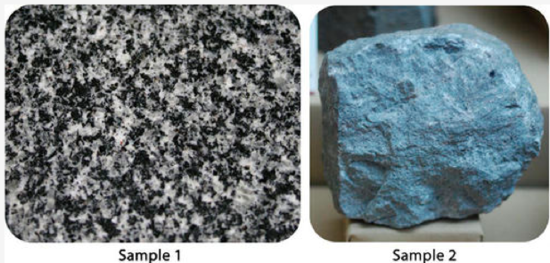
| Sample | Minerals | Texture | Formation | Rock Type |
| Sample 1 | plagioclase, quartz, hornblende, pyroxene | Crystals, visible to the naked eye | Magma cooled slowly | Diorite |
| Sample 2 | plagioclase, hornblende, pyroxene | Crystals are tiny or microscopic | Magma erupted and cooled quickly | Andesite |
Table 1
As seen in table 1, these two rocks have the same chemical composition and contain mostly the same minerals, but they do not have the same texture. Sample 1 has visible mineral grains, but Sample 2 has very tiny or invisible grains. The two different textures indicate different histories. Sample 1 is a diorite, a rock that cooled slowly from magma (molten rock) underground. Sample 2 is an andesite, a rock that cooled rapidly from a very similar magma that erupted onto Earth’s surface.


